
Cell Biology Notes are the cornerstone of success for any aspiring medical professional or science student. Whether you’re preparing for NEET, BSc Nursing entrance exams, or simply aiming to ace your Class 11 Biology, a solid understanding of cell biology is non-negotiable. This comprehensive guide provides essential Cell Biology Notes, meticulously extracted from NCERT, focusing on high-yield concepts and potential question areas. Dive in to empower your learning with these crucial Cell Biology Notes!
The Fundamental Unit: A Journey Through Discovery (Cell Biology Notes)
The journey into Cell Biology begins with its fascinating history. The cell, the basic unit of life, was first observed by Robert Hooke in cork. However, it was Antonie van Leeuwenhoek who first described a live cell. The nucleus, a prominent organelle, was later discovered by Robert Brown. These historical milestones form critical aspects of Cell Biology.
The Cell Theory, a foundational concept in Cell Biology Notes, evolved through the contributions of M. Schleiden (plants are made of cells) and T. Schwann (animals are made of cells, and plasma membrane exists). The modern understanding of cell theory was solidified by Rudolf Virchow with his seminal statement, “Omnis cellula-e cellula,” meaning all cells arise from pre-existing cells. This is a vital piece of information for any student revising their Cell Biology Notes.
Attempt This Quiz After Reading This Article
Diverse World of Cells: Sizes, Shapes, and Types (Essential Cell Biology Notes)
Cells exhibit incredible diversity in size and shape. Your Cell Biology Notes should highlight these specifics:
| You Tube | Click Here |
| Click Here | |
| Telegram | Click Here |
- The smallest cell is Mycoplasma (0.3μm).
- The largest isolated single cell is the egg of an ostrich (15 × 13) cm.
- Human RBCs are about 7.0 μm in diameter.
- Nerve cells are among the longest cells.
Understanding the two fundamental types of cells – prokaryotic and eukaryotic – is paramount for comprehensive Cell Biology Notes.
Prokaryotic vs. Eukaryotic Cells: A Core Comparison for Your Cell Biology Notes
This table provides a high-yield comparison, perfect for quick revision of your Cell Biology Notes:
| Feature | Prokaryotic Cell | Eukaryotic Cell |
| Size | Generally small (1-5μm ) | Larger (10-100 μm) |
| Nucleus | Absent; genetic material is naked in a “Nucleoid” | Present; well-defined with nuclear envelope |
| Genetic Material | Single circular DNA; No Histones | Multiple linear chromosomes with Histones |
| Membrane Organelles | Absent (No Mitochondria, Golgi, ER) | Present (Mitochondria, Golgi, ER, etc.) |
| Ribosomes | 70S (50S + 30S subunits) | 80S (60S + 40S subunits) |
| Cell Wall | Complex; made of Peptidoglycan (in bacteria) | Simple; Cellulose (plants) or Chitin (fungi) |
| Cell Division | Binary fission (Simple) | Mitosis or Meiosis (Complex) |
| Examples | Bacteria, Cyanobacteria, Mycoplasma | Plants, Animals, Fungi, Protists |
This comparison is a must-have for your Cell Biology Notes.
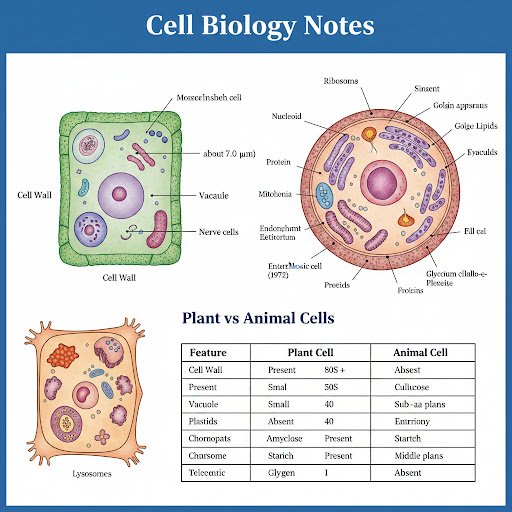
The Intricate World of Eukaryotic Cells: Organelles and Functions (Detailed Cell Biology Notes)
Eukaryotic cells are a complex marvel, housing specialized membrane-bound organelles. Understanding each component is crucial for thorough Cell Biology Notes.
A. Cell Membrane: The Dynamic Barrier
The Fluid Mosaic Model, proposed by Singer and Nicolson (1972), best describes the plasma membrane. It’s a dynamic structure of lipids (phospholipid bilayer) and proteins. Remember, human RBC membranes specifically contain about 52% protein and 40% lipids – a common exam fact for Cell Biology Notes! Its fluidity is vital for cell functions like growth and secretion.
B. Cell Wall: The Protective Outer Layer
Beyond the plasma membrane, plant cells and algae boast a cell wall.
- Algae: Cellulose, galactans, mannans, and calcium carbonate.
- Plants: Cellulose, hemicellulose, pectins, and proteins.
The Middle Lamella, made of calcium pectate, glues adjacent cells. Plasmodesmata are cytoplasmic connections between cells. These details are key for robust Cell Biology Notes.
C. The Endomembrane System: A Coordinated Network
This system includes the Endoplasmic Reticulum (ER), Golgi apparatus, Lysosomes, and Vacuoles. Importantly, mitochondria, chloroplasts, and peroxisomes are not part of this system.
Also Read This: Laws of Motion Explanation, Examples & Applications
- Endoplasmic Reticulum (ER):
- Rough ER (RER): Studded with ribosomes, involved in protein synthesis and secretion.
- Smooth ER (SER): Lacks ribosomes, crucial for lipid synthesis (and steroid hormones).
- Golgi Apparatus: Discovered by Camillo Golgi, it’s the site of glycoprotein and glycolipid formation. Materials move from the cis (forming) face to the trans (maturing) face. This is a high-yield topic for Cell Biology Notes.
- Lysosomes: Often called “suicidal bags,” they are rich in hydrolytic enzymes (hydrolases) active at an acidic pH, breaking down cellular waste.
- Vacuoles: Bounded by a single membrane called the tonoplast. In plant cells, they can occupy up to 90% of the cell volume, maintaining turgor.
D. Energy Transformers: Mitochondria and Plastids
These organelles are powerhouses and food factories, essential to include in your Cell Biology Notes.
- Mitochondria: Double-membraned, with inner membrane infoldings called cristae. They are the sites of aerobic respiration and ATP production (the “Powerhouse of the Cell”). Notably, they contain their own circular DNA, RNA, and 70S ribosomes – a crucial detail for advanced Cell Biology Notes.
- Plastids: Found in plant cells.
- Chloroplasts: Contain chlorophyll, the site of photosynthesis.
- Chromoplasts: Contain fat-soluble carotenoid pigments (carotene, xanthophylls), giving color to fruits and flowers.
- Leucoplasts: Colorless plastids for storage: Amyloplasts (starch), Elaioplasts (oils), Aleuroplasts (proteins).
E. Ribosomes: Protein Factories
First observed by George Palade (1953), ribosomes are responsible for protein synthesis. Eukaryotic ribosomes are 80S type (composed of 60S and 40S subunits). Remember, “S” refers to the Svedberg unit, a measure of sedimentation coefficient. Don’t forget this in your Cell Biology Notes!
F. Cytoskeleton & Motility: Shape and Movement
- Cilia/Flagella: Hair-like outgrowths, covered by the plasma membrane. Their core, the axoneme, shows a characteristic 9 + 2 array of microtubules.
- Centrosome/Centrioles: Contain two cylindrical centrioles arranged perpendicular to each other. Centrioles exhibit a 9 + 0 arrangement (9 peripheral microtubule triplets, no central ones). They form the basal body of cilia/flagella and organize spindle fibers during cell division. Include these structural details in your Cell Biology Notes.
G. Nucleus: The Control Center
The nucleus houses the cell’s genetic material.
- Chromatin: The genetic material (DNA, histones, non-histone proteins, RNA) was termed by Flemming.
- Nucleolus: The site for rRNA synthesis.
- Chromosomes: Their morphology is based on centromere position:
- Metacentric: Middle centromere (V-shape).
- Sub-metacentric: Slightly away from middle (L-shape).
- Acrocentric: Close to end (J-shape).
- Telocentric: Terminal centromere (I-shape).
This classification is often tested and should be in your Cell Biology Notes. A satellite refers to a non-staining secondary constriction at a constant location.
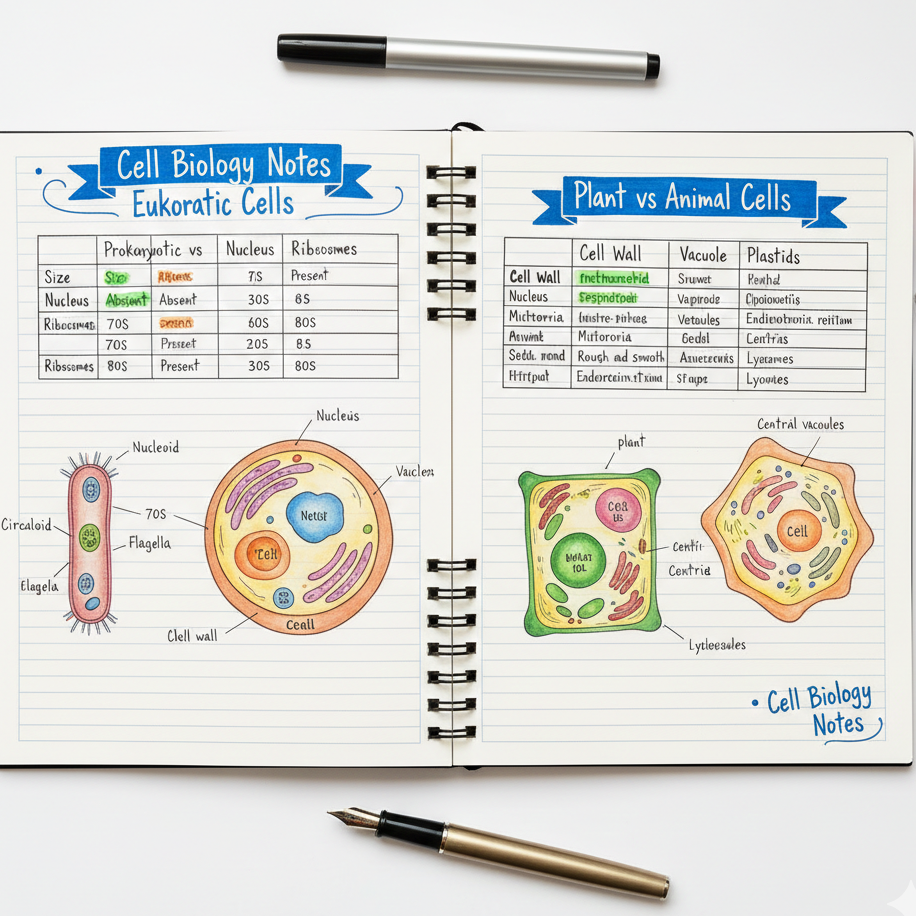
Plant vs. Animal Cells: Key Distinctions for Your Cell Biology Notes
While both are eukaryotic, plant and animal cells have distinct features. This comparison is vital for comprehensive Cell Biology Notes.
| Feature | Plant Cell | Animal Cell |
| Cell Wall | Present (made of Cellulose) | Absent |
| Shape | Fixed, usually rectangular/hexagonal | Irregular or round |
| Vacuole | Large central vacuole (takes up 90% space) | Small and temporary (many) |
| Plastids | Present (Chloroplasts, Chromoplasts, etc.) | Absent |
| Centrioles | Absent (in higher plants) | Present (help in cell division) |
| Lysosomes | Very rare (Vacuoles perform similar roles) | Present and numerous |
| Storage Food | Starch | Glycogen |
| Middle Lamella | Present (connects adjacent cells) | Absent |
This table clarifies key differences, making your Cell Biology Notes even more effective for revision.
Click here to get Short Notes PDF